ATLAS-ENT-01 · Public demo · private production
Atlas Intelligence Enterprise
An evidence-grounded program intelligence workspace that turns fragmented project artifacts into decision-ready intelligence through a coordinated network of specialist agents.The challenge
Executive program questions were distributed across artifacts, systems, and institutional knowledge.
Consequential program decisions are often spread across charters, status reports, decision logs, governance commitments, and institutional knowledge. Atlas Intelligence Enterprise creates one traceable workspace for finding what changed, why it matters, and what needs attention next.
The approach
Break the decision into evidence, rules, and authority.
- 01
Mapped recurring executive questions to explicit evidence requirements.
- 02
Separated specialist analysis into typed, inspectable agent workflows.
- 03
Designed review, escalation, and audit paths before adding model-backed interpretation.
Architecture / system
A connected operating system for the decision.
- Ten specialist agents coordinated through typed schemas and a shared orchestration layer
- Five intelligence workflows spanning executive readiness, status interrogation, decision provenance, invisible work, and governance
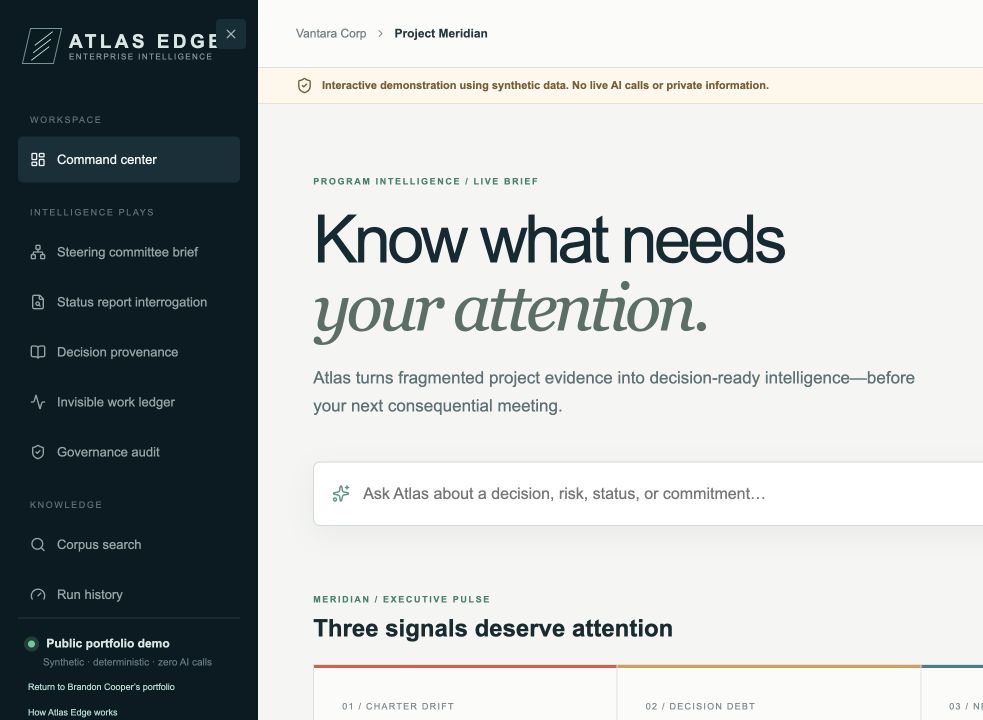
- Evidence search, source-linked findings, scenario snapshots, audit history, working notes, and exports
- Separate public and private runtimes with deterministic synthetic data and zero live AI calls in the public demo
Product experience
AI design
What the model does
Interprets evidence, compares artifacts, and drafts source-linked findings.
What remains explicit
Schemas, workflow state, access rules, evidence references, and audit history remain deterministic.
Where judgment remains
Leaders review findings, resolve gaps, and retain authority over every consequential decision.
Outcome
Made executive-readiness questions answerable from source-linked evidence instead of fragmented program artifacts, with clear escalation paths when the evidence is incomplete.
- 10 specialist agents
- 5 decision workflows
- Source-linked findings + audit history
Project facts:Role: product strategy, agentic system architecture, governance and safety design, and enterprise experience design. The public Meridian workspace is fictional, deterministic, and designed for safe exploration; the private application retains evidence ingestion, persistence, agent orchestration, and optional model-backed analysis.
07 · Lesson / perspective
Agentic systems become useful when coordination, evidence, and authority are designed as one operating model.