5Mission portfolios governed across product, engineering, risk, and compliance
20+Operating procedures redesigned or automated
100+Risks, issues, and dependencies helped to mitigate
300+Higher-education clients supported
Experience shaped across Freddie MacSmartsheetCareFirstServiceNowEllucian
What collaborators can expect
Clarity that holds up under pressure.
Brandon brings structure to difficult decisions without stripping away their nuance. Leaders leave with clearer evidence, ownership, and next steps.
Executive Portfolio Leader
He connects product ambition with the governance required to make it credible in production.
Responsible AI Leader
Brandon translates complex operating realities into systems that teams can understand, challenge, and use.
Enterprise Architecture Leader
His work makes risk visible early while preserving momentum and accountable human judgment.
Risk & Compliance Stakeholder
Selected work
Things I’m building
Each project starts with the decision it changes, the evidence behind it, and the human authority that remains in control.
01
Enterprise intelligence · Agentic systems
Public demo · private production
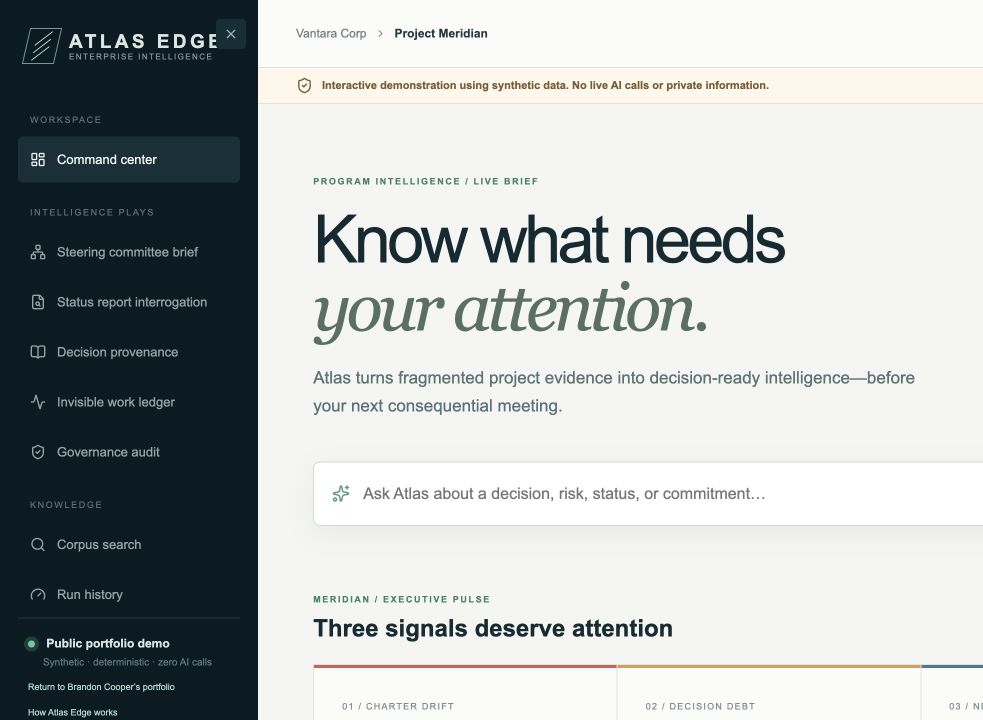
Atlas Intelligence Enterprise
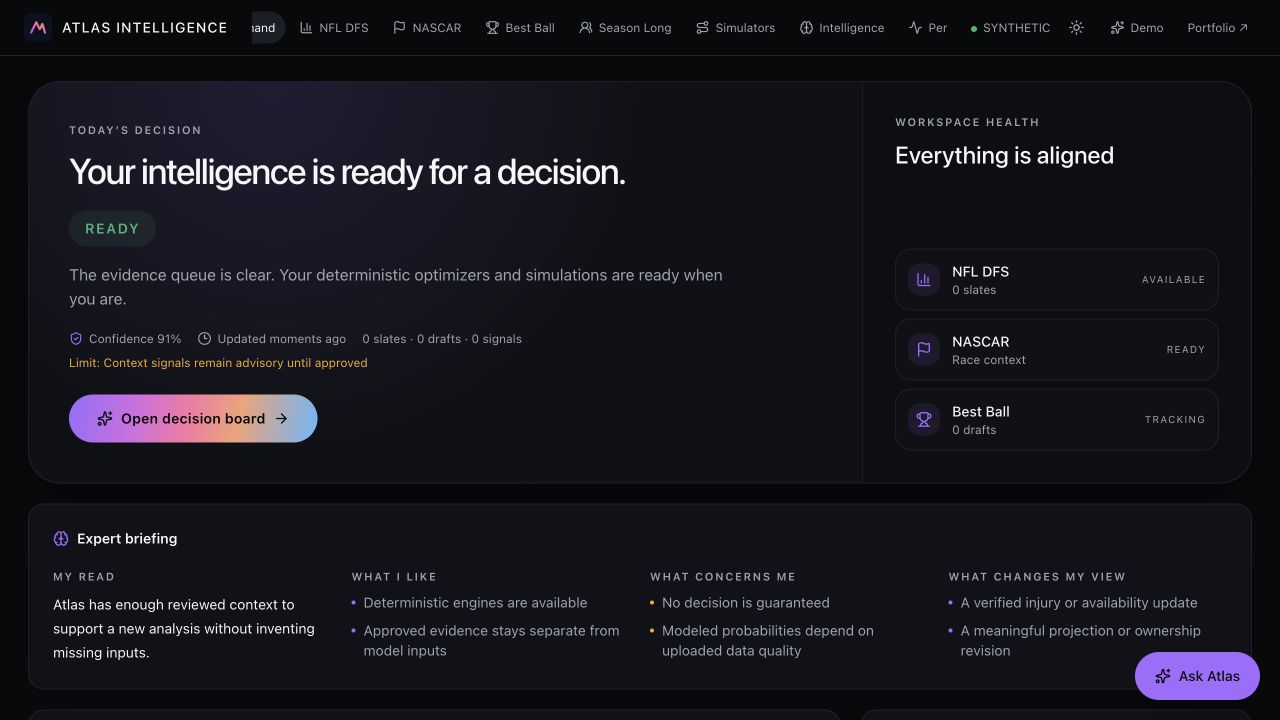
An evidence-grounded program intelligence workspace that turns fragmented project artifacts into decision-ready intelligence through a coordinated network of specialist agents.
Decision impact
Made executive-readiness questions answerable from source-linked evidence instead of fragmented program artifacts, with clear escalation paths when the evidence is incomplete.
10 specialist agents5 decision workflowsSource-linked findings + audit history
My role: Product strategy, agentic system architecture, governance and safety design, and enterprise experience design.
Synthetic application preview · Open the decision-impact story
Deep diveProblem, system, and architecture notes+
The problem
Consequential program decisions are often spread across charters, status reports, decision logs, governance commitments, and institutional knowledge. Atlas Intelligence Enterprise creates one traceable workspace for finding what changed, why it matters, and what needs attention next.
What it brings together
Ten specialist agents coordinated through typed schemas and a shared orchestration layer
Five intelligence workflows spanning executive readiness, status interrogation, decision provenance, invisible work, and governance
Evidence search, source-linked findings, scenario snapshots, audit history, working notes, and exports
Separate public and private runtimes with deterministic synthetic data and zero live AI calls in the public demo
Project facts: Role: product strategy, agentic system architecture, governance and safety design, and enterprise experience design. The public Meridian workspace is fictional, deterministic, and designed for safe exploration; the private application retains evidence ingestion, persistence, agent orchestration, and optional model-backed analysis.
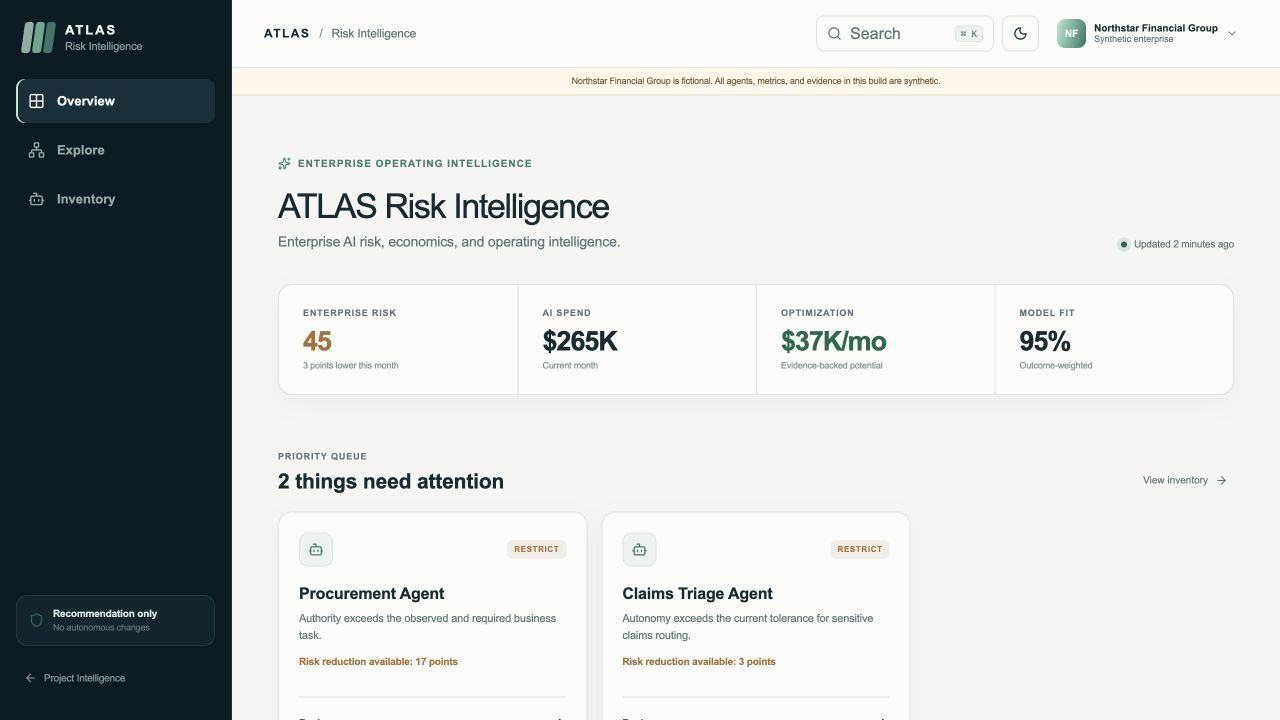
An enterprise operating-intelligence workspace that connects AI-agent risk, economics, authority, and evidence so leaders can decide what to keep, optimize, restrict, or escalate.
Decision impact
Turned fragmented AI ownership, spend, permissions, and risk into a common decision surface for comparing operating envelopes before people authorize change.
Deterministic risk budgetsHuman approval for every production changeAgent-to-data lineage
My role: Product strategy, risk-intelligence architecture, deterministic decision-model design, and governance boundaries.
Synthetic application preview · Open the decision-impact story
Deep diveProblem, system, and architecture notes+
The problem
Enterprise AI agents accumulate fragmented ownership, permissions, model spend, and operational risk. Risk Intelligence creates a decision-ready view of each agent’s operating envelope and the evidence behind recommended changes.
What it brings together
Deterministic blast-radius, residual-risk, risk-budget, and model-fit analysis
Agent inventory with ownership, autonomy, permissions, spend, outcomes, and recommendation states
Enterprise graph connecting agents, models, tools, and sensitive data
Evidence-backed counterfactual operating envelopes with human approval required for every production change
Project facts: Role: product strategy, risk-intelligence architecture, deterministic decision-model design, governance and safety boundaries, and enterprise experience design. The public Northstar workspace is fictional, deterministic, and makes no live AI calls. Recommendations are advisory; humans authorize and execute every production change.
An evidence-backed mortgage-market intelligence workspace that ranks deterioration signals, explains their drivers, and preserves a verifiable record of how each conclusion was produced.
Decision impact
Made market-deterioration rankings inspectable and reproducible, separating deterministic scoring from AI-supported interpretation and borrower-level decisions.
Synthetic application preview · Open the decision-impact story
Deep diveProblem, system, and architecture notes+
The problem
Mortgage-market evidence is fragmented across economic, housing, rate, and portfolio signals. Atlas Mortgage Intelligence converts those inputs into a transparent ranked view without asking an AI model to calculate the score or make borrower-level decisions.
What it brings together
Deterministic 0–100 deterioration scoring from normalized public and open market inputs
Specialist agents for evidence retrieval, interpretation, comparison, and citation-grounded explanation
Market rankings, drill-downs, component contributions, freshness, confidence, and coverage
Tamper-evident hash-chain ledger with dataset snapshots, version provenance, and verification receipts
Project facts: Independent proof of concept built with verified public/open sources and a generated 25,000-row synthetic mortgage portfolio. The local MVP does not require an OpenAI key. It is not affiliated with Freddie Mac and does not provide lending, investment, legal, compliance, appraisal, underwriting, or credit advice. A credential-free public demo is planned.
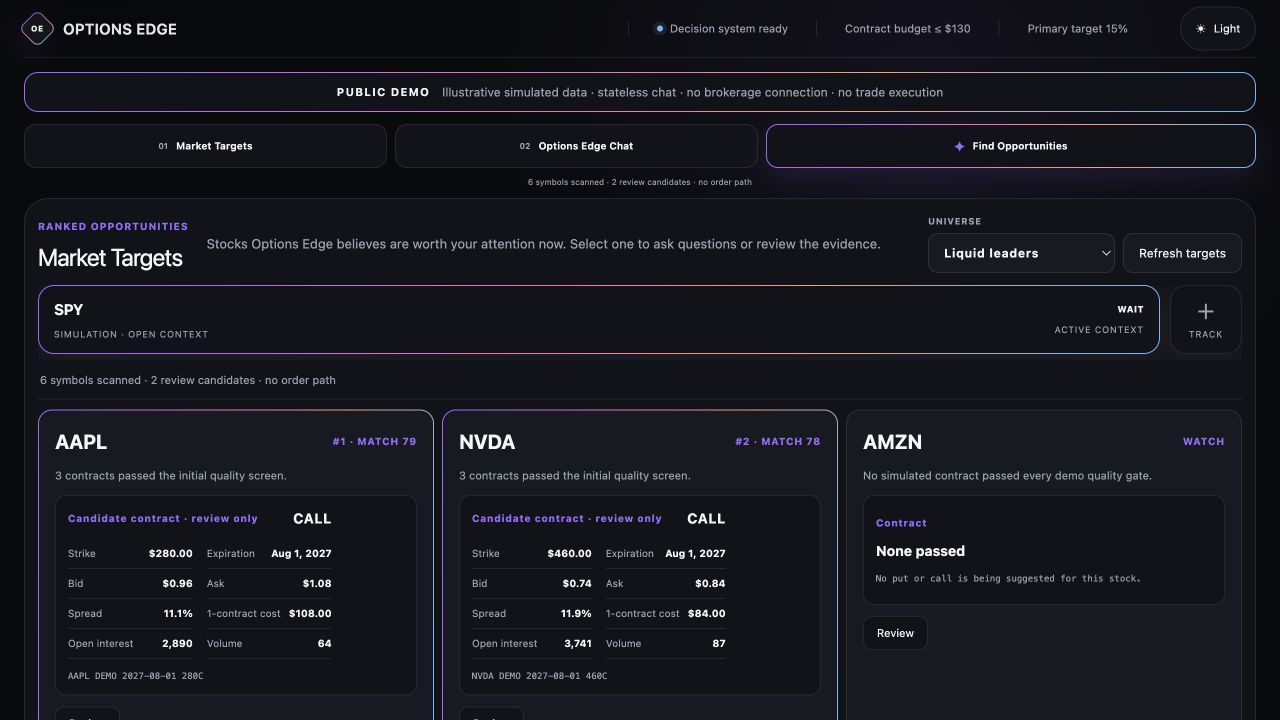
A completed, simulation-only command center that turns live market evidence into structured, explainable options decisions while keeping execution human-controlled.
Decision impact
Converted noisy options data into a gated review workflow that explains why a setup advances, fails, or needs human judgment—without automating execution.
Live read-only market dataDeterministic quality gatesManual execution boundary
My role: Product strategy, decision-system architecture, AI experience design, and safety-boundary design.
Synthetic application preview · Open the decision-impact story
Deep diveProblem, system, and architecture notes+
The problem
Options analysis creates an abundance of data but not necessarily clarity. Options Edge converts live market evidence into a disciplined review workflow while preserving manual execution and explicit human judgment.
What it brings together
Live read-only Schwab market data and five-minute price history
Options-chain screening with deterministic setup, contract, quality, and execution-economics gates
Context-aware AI conversation, manual trade intake, and active-trade monitoring
Long Shot research plus replay, calibration, and audit tools
Project facts: Stack: Schwab API and OAuth, OpenAI API, deterministic policy gates, encrypted token storage, and a simulation-only execution model. Role: product strategy, decision-system architecture, AI experience design, and safety-boundary design. Outcome: delivered an end-to-end decision-support application that produces explainable review states while keeping execution manual. Public demo planned; production remains private.
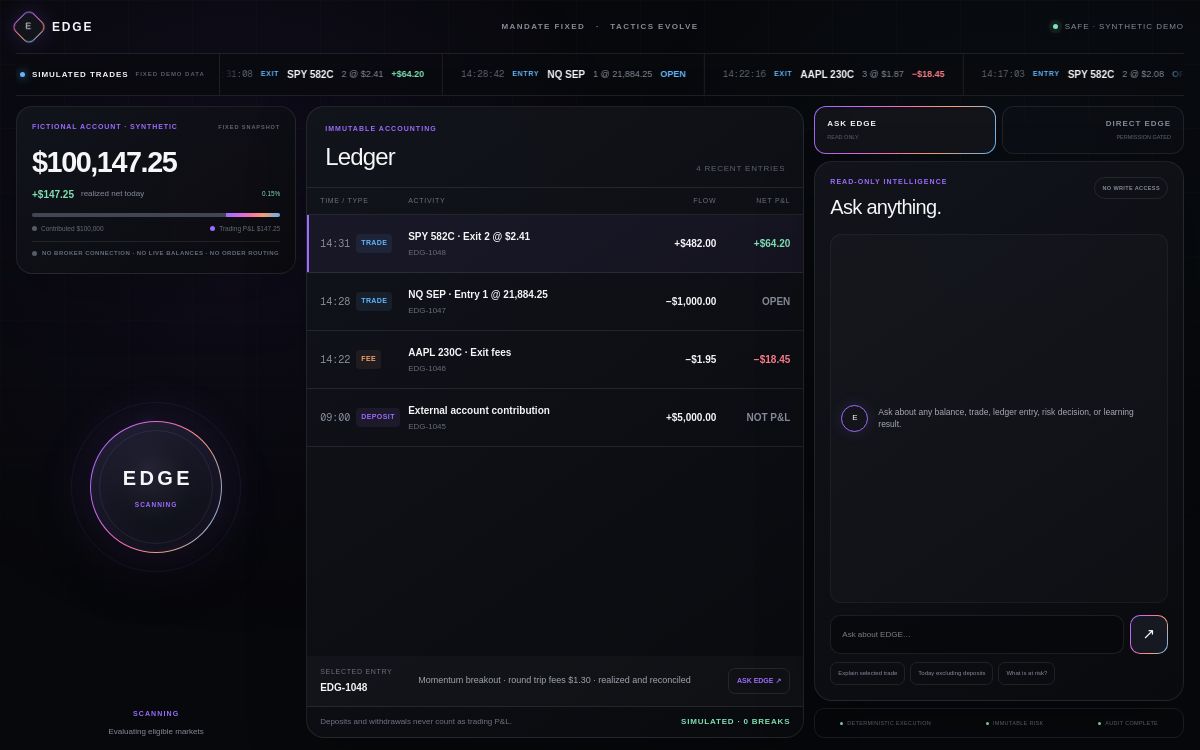
A paper-trading control system that combines deterministic risk gates, immutable accounting, reconciliation, and permission-aware intelligence while keeping live-capital execution disabled.
Decision impact
Established the accounting, reconciliation, and authorization controls required to evaluate autonomous trading safely before live capital can ever be enabled.
Immutable paper ledgerPre-trade risk kernelLive execution disabled by design
My role: Product strategy, system architecture, risk-control design, agent experience, and implementation governance.
Synthetic application preview · Open the decision-impact story
Deep diveProblem, system, and architecture notes+
The problem
A credible trading system needs more than a signal or an attractive interface. EDGE Trading is being built around accounting integrity, pre-trade constraints, auditable state, and explicit authorization boundaries before any broker execution can be considered.
What it brings together
One-screen paper account balance, live trade tape, immutable ledger, and reconciliation state
Deterministic pre-trade risk kernel with stop-plan and net-expectancy gates
Broker-neutral canonical models with deposits separated from realized trading P&L
ASK EDGE read-only intelligence and permission-gated DIRECT EDGE controls
Safety boundary: Current state: active paper-trading system with deterministic demonstration data and a public read-only preview. Live brokerage order submission remains disabled until the OMS, position guardian, reconciliation, ledger, adapter certification, safety verification, paper soak, shadow comparison, and explicit limited-live authorization gates are complete.
A multi-sport decision workspace that combines validated data, deterministic optimization, simulation, and explainable portfolio analysis.
Decision impact
Made optimization choices and constraint failures visible, so users can challenge projections, exposure, and scenarios instead of accepting a black-box lineup.
4 sport workflows7-lineup portfolio optimizationMonte Carlo scenario analysis
My role: Product strategy, optimization workflow design, simulation framing, explainability, and product experience.
Synthetic application preview · Open the decision-impact story
Deep diveProblem, system, and architecture notes+
The problem
Sports decisions require disciplined handling of projections, constraints, uncertainty, and competing scenarios. Atlas Sports Intelligence turns those inputs into transparent workflows that can be inspected and challenged.
What it brings together
NFL single-lineup optimization and seven-lineup portfolio construction
Exposure controls, stacking rules, and structured infeasibility explanations
Monte Carlo simulation plus projection-accuracy learning
Dedicated NASCAR, Best Ball, and season-long workflows
Public demo: This public environment uses fictional players and deterministic demonstration data. It does not use Brandon’s private production data, call OpenAI, or provide guaranteed wagering outcomes.
A reusable architecture for translating specialist judgment into grounded, governed, and adaptive intelligence products that can move from idea to production.
Decision impact
Created a reusable path from an ambiguous AI idea to build-ready specifications, accountable decision rights, evaluation criteria, and controlled production change.
7-stage intake framework4 connected design disciplinesGovernance designed into delivery
My role: Framework author, product architect, governance designer, and creator of the supporting field guides and implementation artifacts.
Deep diveProblem, system, and architecture notes+
The problem
Expert knowledge is often implicit, fragmented, and difficult to operationalize. Atlas EDGE creates an architectural path from outcomes and workflows through data, governance, experience design, validation, and accountable delivery.
What it brings together
Target-state architecture, reusable patterns, integrations, and security posture
Decision rights, ownership, policies, controls, and human oversight
Grounded data and knowledge with visible source-to-output lineage
Evaluation scorecards, production runbooks, monitoring, and controlled change
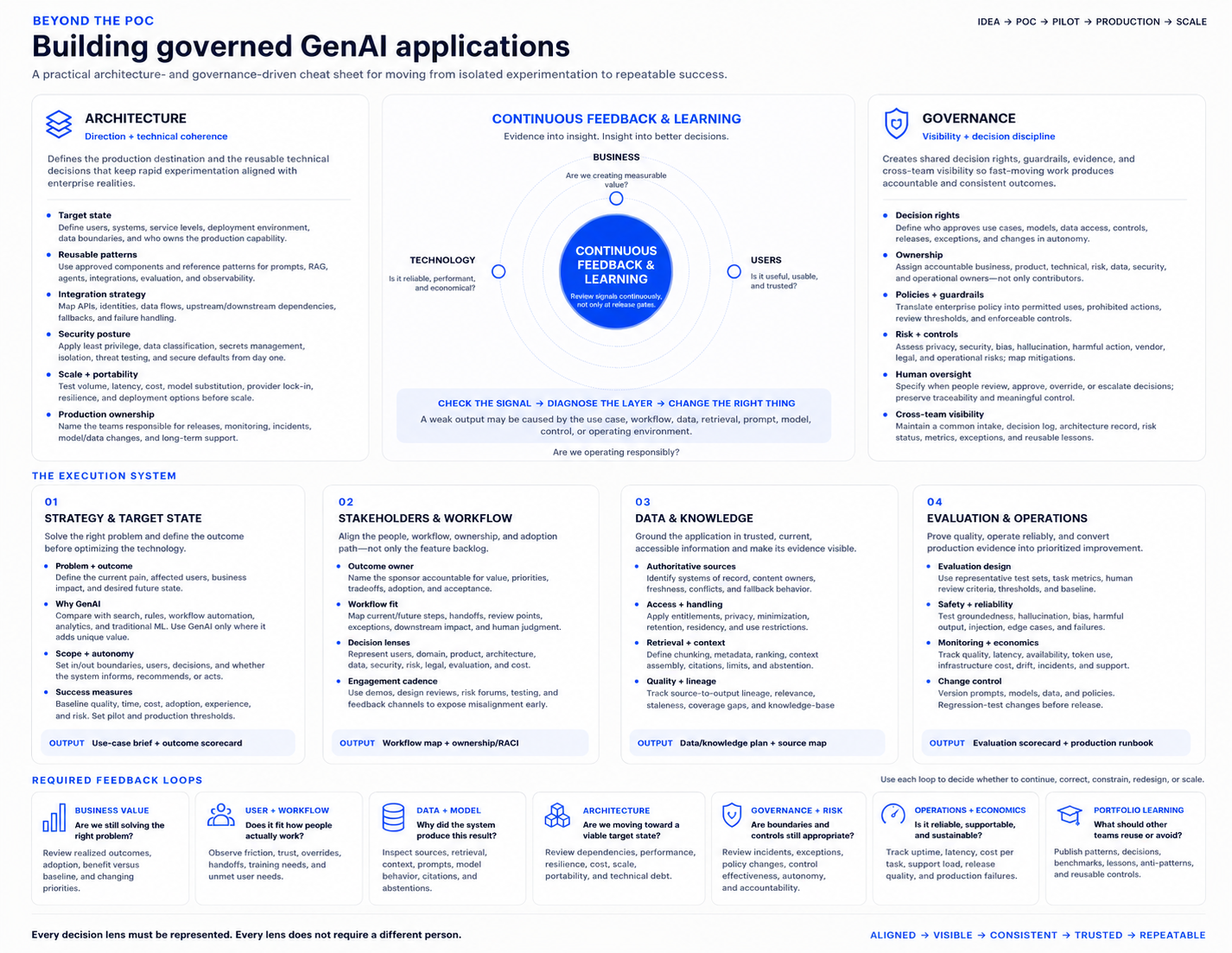
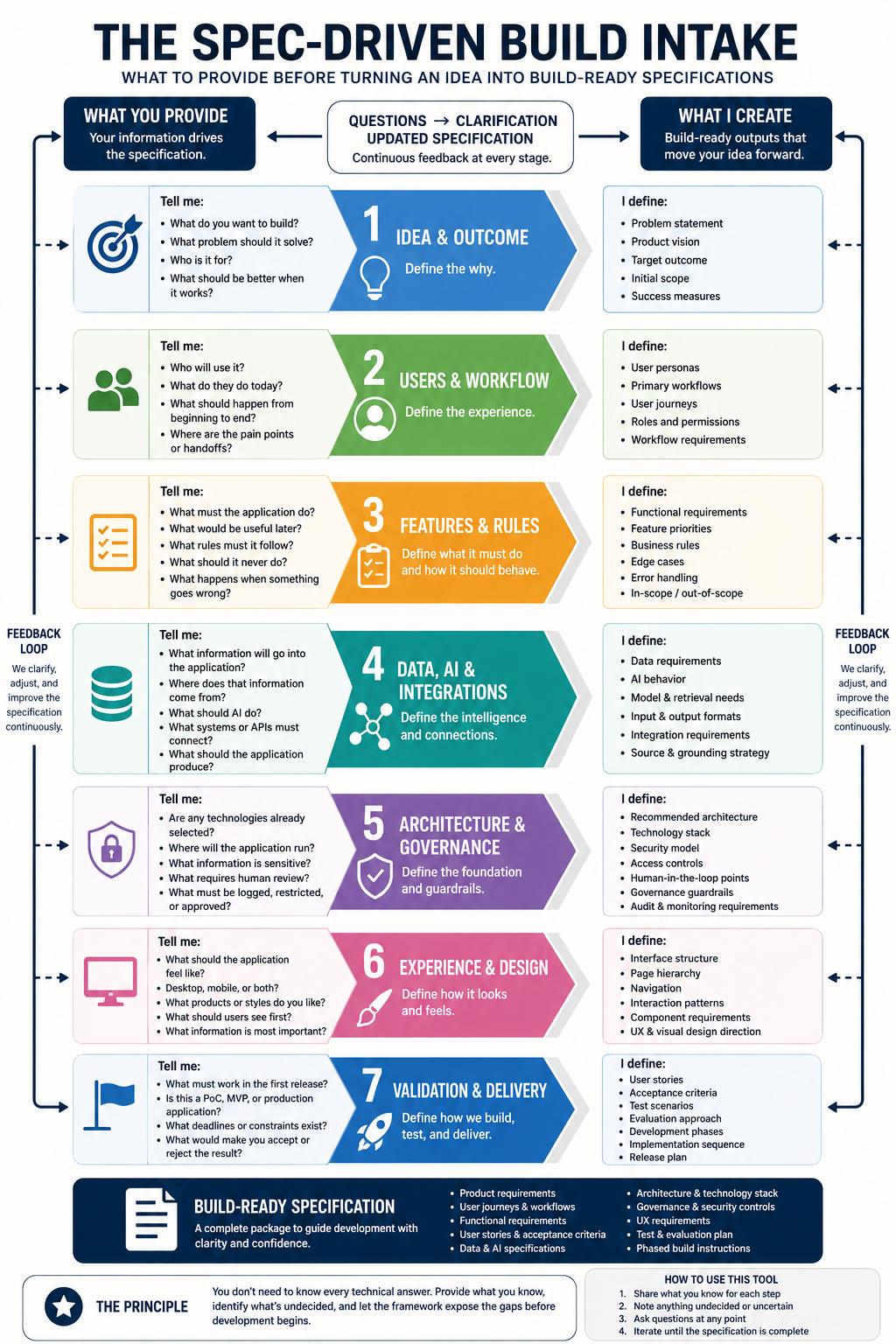
Architecture in practice: Representative implementation: the Spec-Driven Build Intake Framework turns an idea into build-ready specifications across seven connected stages. Evaluation is designed into the architecture through success measures, acceptance criteria, test scenarios, source grounding, safety and reliability checks, human review, monitoring, and continuous feedback loops.
From governed system design to build-ready specifications.
These two working artifacts show Atlas EDGE at different levels: the production architecture and governance system, then the intake method used to define a specific application.
Architecture field guide · PDF
Building Governed GenAI Applications
Production architecture, governance decision rights, execution layers, evaluation operations, and required feedback loops.Download PDF ↓
Representative implementation · PNG
Spec-Driven Build Intake Framework
A seven-stage feedback-driven intake model covering outcomes, workflows, rules, integrations, governance, design, and delivery.Download diagram ↓
More work is coming
I’m keeping the portfolio intentionally small until each project has a clear story and something useful to share.
How I work
Atlas EDGE
A simple framework I use to move from expert knowledge to a product people can trust and use.
1
Extract
Understand the decisions, signals, and judgment that matter.
2
Design
Turn that knowledge into a clear product and interaction.
3
Ground
Connect it to reliable context, tools, and human review.
4
Evolve
Learn from real use without losing quality or intent.
How I think
Judgment before automation.
01
Make the decision visible
Start with who must decide, what evidence they need, and what happens when confidence is low.
02
Separate intelligence from authority
Models can interpret and recommend. Deterministic controls and accountable people decide what may act.
03
Design for challenge
Good systems expose sources, assumptions, uncertainty, and alternatives so users can disagree intelligently.
Atlas EDGE · One-page field guide
Take the operating model into your next product conversation.
Share only what is safe to share. Atlas will frame the decision, evidence, human authority, and first practical move.
Experience
From enterprise transformation to agentic product systems.
My career has centered on one recurring challenge: turning complicated operating realities into clear systems, decisions, and outcomes.
I work at the intersection of product strategy, enterprise delivery, business architecture, and AI. Across regulated and complex environments, I’ve built the governance, workflows, and decision structures that help specialized expertise become usable—and increasingly, intelligent—products.
10+Years across programs, products, and transformation
5Mission portfolios governed in my current role
20+Procedures redesigned or automated
300+Higher-education clients supported
Career story
A progression through delivery, process, architecture, portfolio strategy, and applied AI.
Oct 2022 — Present
Freddie Mac
Program Manager Sr.
Govern strategic delivery across five mission portfolios, aligning product, engineering, architecture, operations, risk, and compliance.
Architected an AI-enabled RAG governance solution with source transparency, review checkpoints, escalation controls, and human oversight.
Led practical Responsible AI education and redesigned or automated more than 20 procedures using Lean Six Sigma practices.
May — Oct 2022
Smartsheet
Solutions Consultant
Led enterprise discovery, target-state solution planning, roadmaps, and adoption strategy.
Aug 2021 — May 2022
FEPOC / CareFirst BlueCross BlueShield
Business Architect · Contract
Designed ePMO intake, prioritization, decision rights, portfolio visibility, capability models, and BPMN 2.0 processes.
May — Aug 2021
ServiceNow
Digital Solutions Consultant
Advised Fortune 100 clients on ITBM/SPM governance and adoption; résumé reports 5%+ pipeline growth and approximately $250K in net-new annual contract value.
Jan 2019 — May 2021
FEPOC / CareFirst BlueCross BlueShield
Process Governance & Quality Assurance
Supported governance across more than 25 teams and helped mitigate more than 100 risks, issues, and dependencies.
May 2015 — Jan 2019
Ellucian
Software Analyst · Global Support
Supported more than 300 higher-education clients and release readiness across multiple cross-functional projects.
May 2014 — May 2015
National Automobile Dealers Association
Project Manager · Compliance
Led the compliant transition of 350 defined-benefit plans to a new benefits platform.
Education
MBA, Kansas Wesleyan University
B.S. Business Management Administration, Strayer University
Selected credentials
PMP · PMI-ACP · SAFe
Prosci Change Management · Lean Six Sigma Green Belt · Enterprise Architecture · Certified ScrumMaster
AI learning
Agentic AI for Business Managers
Georgetown University · Generative Artificial Intelligence, Villanova University (expected Oct 2026)
What connects the work: I’m most interested in the space between expertise and action—how people make difficult decisions, where knowledge gets lost, and how thoughtful systems can make that intelligence usable at scale.
Explore my experience, projects, strengths, or fit for an opportunity. Answers are grounded in verified résumé and project sources.
A
Bring me a role, a difficult governance question, or a product problem. I’ll connect it to Brandon’s actual work and explain the trade-offs—not just repeat his résumé.