ATLAS-SPT-06 · Interactive demo
Atlas Sports Intelligence
A multi-sport decision workspace that combines validated data, deterministic optimization, simulation, and explainable portfolio analysis.The challenge
Sports optimization hid assumptions and constraint failures behind a single recommended lineup.
Sports decisions require disciplined handling of projections, constraints, uncertainty, and competing scenarios. Atlas Sports Intelligence turns those inputs into transparent workflows that can be inspected and challenged.
The approach
Break the decision into evidence, rules, and authority.
- 01
Modeled constraints and portfolio exposure as visible product inputs.
- 02
Explained infeasibility instead of silently relaxing user intent.
- 03
Used simulation to compare scenarios rather than present certainty.
Architecture / system
A connected operating system for the decision.
- NFL single-lineup optimization and seven-lineup portfolio construction
- Exposure controls, stacking rules, and structured infeasibility explanations
- Monte Carlo simulation plus projection-accuracy learning
- Dedicated NASCAR, Best Ball, and season-long workflows
Product experience
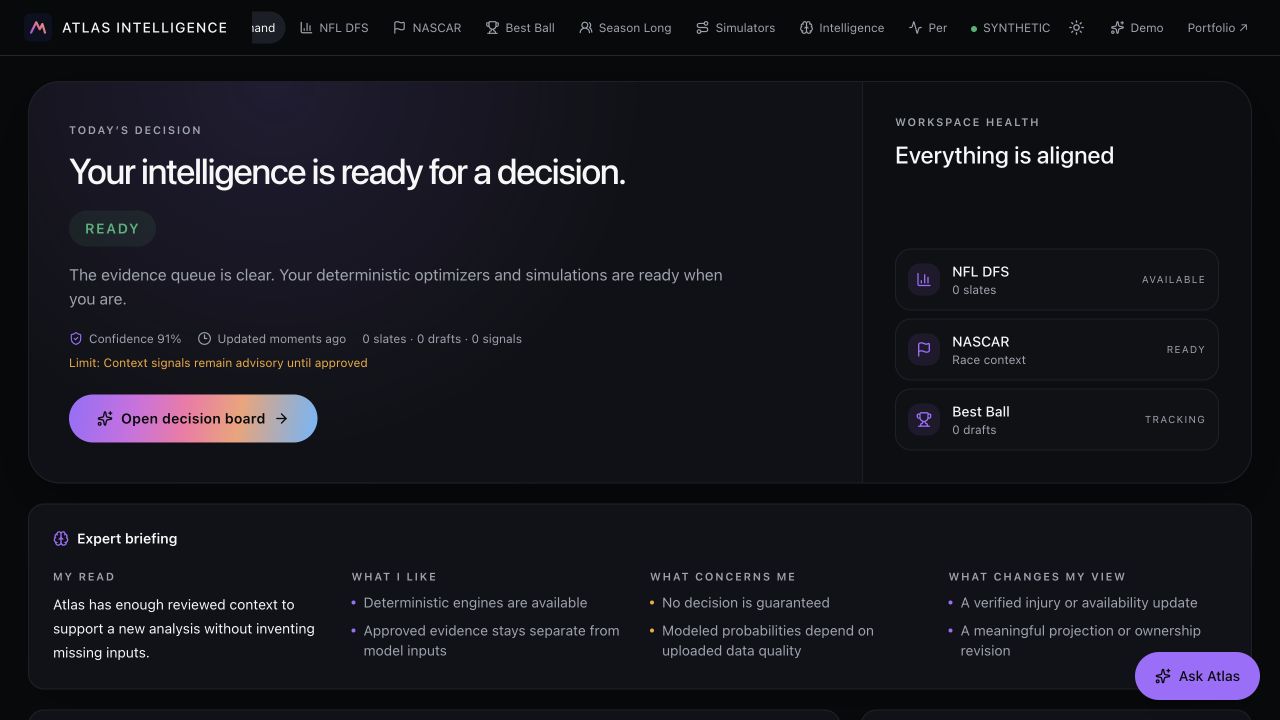
AI design
What the model does
Supports explanation and interrogation of projections and scenarios where appropriate.
What remains explicit
Optimization constraints, portfolio exposure, and demonstration data are reproducible.
Where judgment remains
Users choose assumptions, constraints, and acceptable exposure; no outcome is guaranteed.
Outcome
Made optimization choices and constraint failures visible, so users can challenge projections, exposure, and scenarios instead of accepting a black-box lineup.
- 4 sport workflows
- 7-lineup portfolio optimization
- Monte Carlo scenario analysis
Public demo:This public environment uses fictional players and deterministic demonstration data. It does not use Brandon’s private production data, call OpenAI, or provide guaranteed wagering outcomes.
07 · Lesson / perspective
Optimization becomes decision intelligence when users can challenge its inputs, trade-offs, and failure states.